An OS that watches, learns,
and asks permission.
Radarrr isn’t a chatbot bolted onto a calendar. It’s a set of engines reading your own numbers every day — surfacing what matters, acting inside rules you set, and showing receipts for all of it.
Plain-English questions.
Your own numbers.
“How did injectables do vs last month?” “Who should I win back first?” “What needs my attention today?” The Copilot answers from a live digest of your bookings, revenue, calls, and retention — specific numbers, period comparisons, and one concrete suggested action.
It reads only your own aggregates — no raw client records leave your account, and the deterministic dashboards keep working even without it.
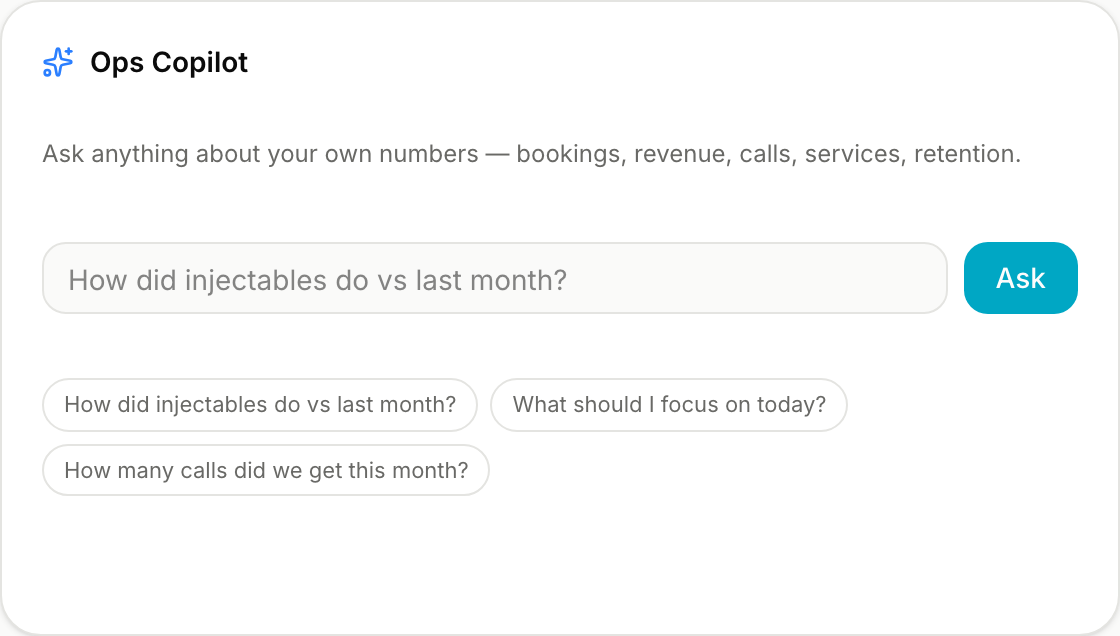
The real panel, on the real dashboard.
The OS proposes.
You dispose.
When the OS wants to reach out on your behalf — win-backs, deposit nudges, recalls — it never just fires. It shows you a named list with the dollars attached. You tap Approve. Then it sends, inside every guardrail.
Want full autonomy later? The Ghost has a dry-run mode that shows exactly who it would text and for how much, every day, until you flip it live.
Standing guard while
you take clients.
Every text teaches it
who to text next.
Every outreach message gets a receipt: sent → replied → booked → dollars. That corpus feeds back into targeting — proven responders float up the list, and anyone who ignores four texts in a row gets rested for 90 days instead of nagged.
And it learns rhythms, not just responses. Cycles are measured per client, per service, from real visit gaps — recall clocks are set to last visit + their cycle, and drift gets caught at ~0.9× of their own rhythm, while a nudge still reads as attentive.
Marketing that knows when to stop is the part nobody else ships.
Every engine,
on the record.
The pulse strip on your dashboard shows every engine breathing — reminders, recovery, recalls, attribution, the Ghost. Each one reports what it did and when (“considered 61 · rested 4 · sent 0”). If something stalls, it shows amber before it costs you money.
Every automated send is also written to an append-only audit log. Autonomy and accountability aren’t a trade-off here — they’re the same feature.
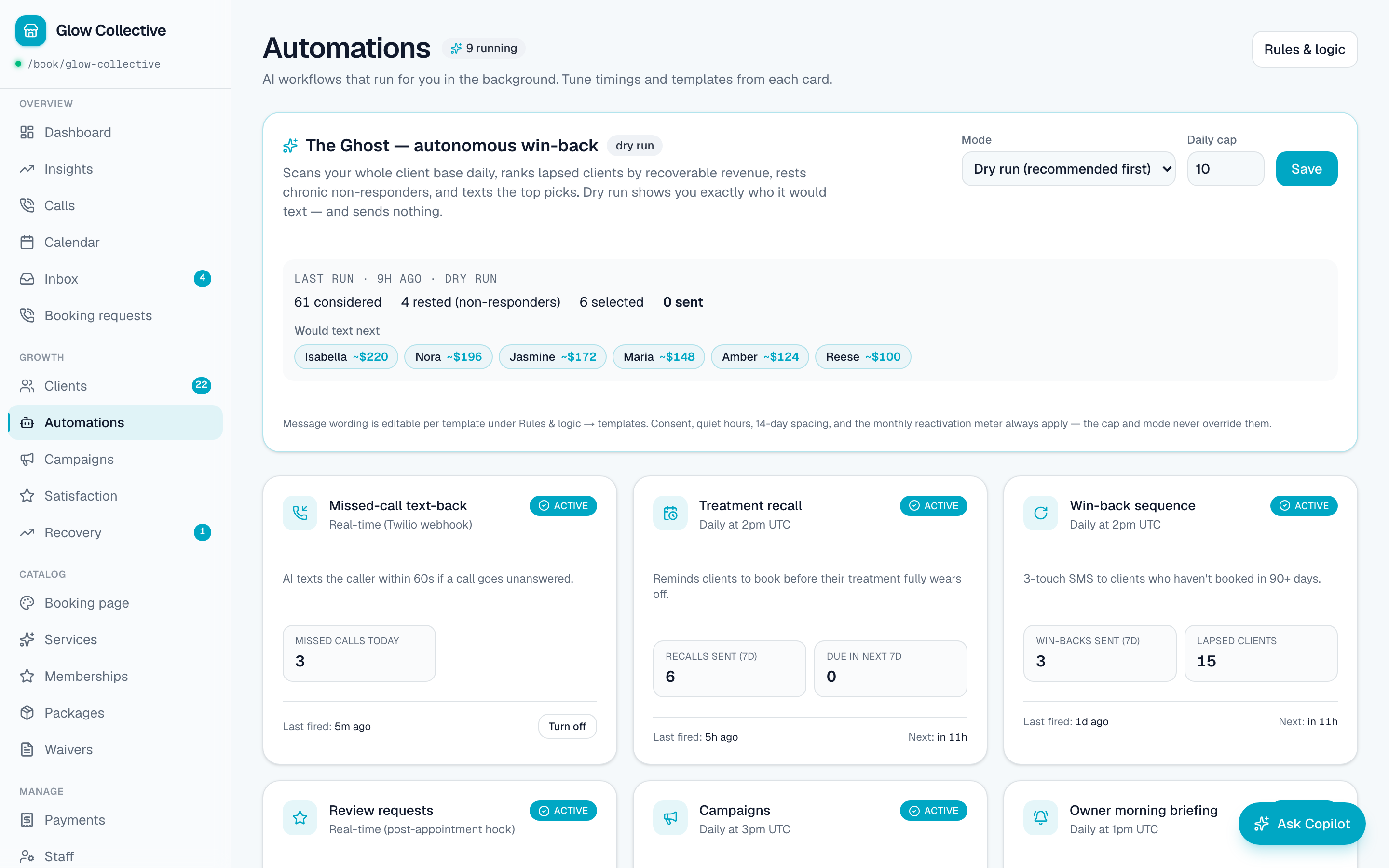
Real automations page: every engine, its last run, and the Ghost’s dry-run receipt.